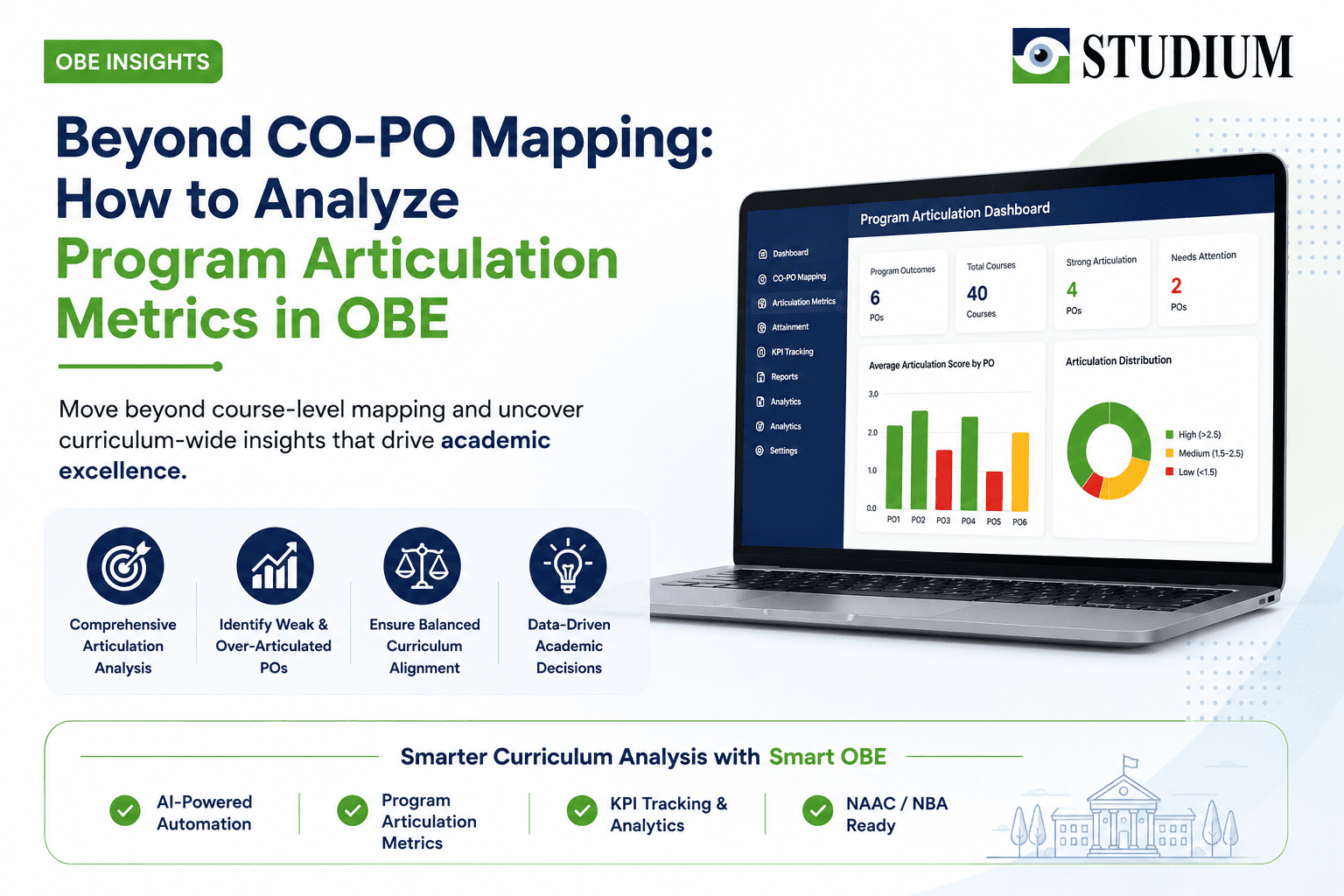
Most institutions stop their Outcome-Based Education (OBE) analysis immediately after completing CO-PO mapping.
Faculty members:
Write Course Outcomes
Map them with Program Outcomes
Calculate attainment
Generate reports
However, one of the most important academic intelligence layers is often completely ignored:
Program Articulation Metrics
Program articulation metrics help institutions understand:
How the curriculum is actually structured
Which Program Outcomes are strongly supported
Which Program Outcomes are neglected
Whether the curriculum is academically balanced
Whether the program is aligned with institutional intent
In simple words:
CO-PO mapping analyzes individual courses.
Whereas:
Program articulation metrics analyze the curriculum as a complete academic ecosystem.
This makes articulation metrics one of the most important tools for:
IQAC teams
Program coordinators
Curriculum committees
Accreditation readiness
In this blog, we will continue the same MBA example used in the CO-PO mapping workbook and understand:
How articulation metrics are created
How to read them
How to identify red flags
How institutions should use them for academic improvement.
This is also one of the core intelligence layers used inside Studium’s Smart OBE framework.
What are Program Articulation Metrics?
Program articulation metrics are curriculum-level analytics that summarize:
“How strongly does the complete program support each Program Outcome?”
Instead of analyzing one course at a time, articulation metrics evaluate:
All courses together
Their contribution to Program Outcomes
The balance of curriculum articulation
Why CO-PO Mapping Alone is Not Enough
A single course may have:
good COs
Proper Bloom’s alignment
Strong mapping values.
However, at the overall curriculum level:
Some Program Outcomes may receive very little support
Some may be excessively mapped
Some may receive only weak articulation.
This creates major academic problems.
For example:
Analytical thinking may dominate the curriculum
While ethics or communication outcomes may remain weak.
Similarly:
Too many courses may weakly map to one Program Outcome
Creating artificial articulation without meaningful learning depth.
This is why institutions must move beyond individual CO-PO matrices and analyze:
Program-wide articulation patterns.
Continuing the MBA Example
Let us continue the same MBA example from the previous workbook.
Assumption:
MBA program has 40 total courses across all semesters.
All courses are mapped to the official AICTE MBA Program Outcomes.
Now imagine that every course has already completed:
CO framing, competency analysis
Bloom’s taxonomy alignment
CO-PO mapping.
The next step is to consolidate this intelligence at the program level.
Step 1: Calculate Average Mapping for Each Course
In the previous CO-PO mapping framework, we calculated:
Horizontal Average
This represented:
“On average, how strongly does this course map to a Program Outcome?”
For example:
Course | PO1 | PO2 | PO3 | PO4 | PO5 | PO6 |
|---|---|---|---|---|---|---|
Marketing Strategies | 1.5 | 2.4 | 0.5 | 2.7 | 1.0 | 2.0 |
This tells us:
1.5 Marketing Strategies strongly contributes to:
PO2 (Analytical Thinking)
PO4 (Problem Solving)
Whereas:
contribution to PO3 and PO5 is weak.
This is not necessarily wrong.
In fact, this is academically healthy because:
not every course should contribute equally to every Program Outcome.
Step 2: Build Program Articulation Matrix
Now imagine that we perform this analysis for all 40 MBA courses.
The articulation matrix now becomes:
Program Outcome | Number of Courses Mapped | Average Mapping Score |
|---|---|---|
PO1 | 28 | 1.9 |
PO2 | 35 | 2.6 |
PO3 | 14 | 1.4 |
PO4 | 31 | 2.5 |
PO5 | 12 | 1.3 |
PO6 | 22 | 2.0 |
This becomes the central articulation intelligence layer.
What Does This Matrix Tell Us?
This matrix gives institutions multiple strategic insights.
Insight 1: Which Program Outcomes Have Least Number of Courses?
Example:
PO5 → only 12 courses mapped
This may indicate:
ethics-related learning is underrepresented
curriculum articulation for ethics is weak
faculty are unable to identify ethical competencies properly.
This becomes a major discussion point for:
IQAC teams
curriculum committees
program coordinators
Insight 2: Which Program Outcomes Have Excessive Mapping?
Example:
PO2 → 35 courses mapped
At first glance, this may look positive.
However, excessive mapping often creates another problem:
Over-articulation.
This may indicate:
faculty are mapping too many courses generically
analytical thinking is becoming an overused Program Outcome
or the curriculum is losing specialization.
This needs careful review.
Insight 3: Average Mapping Strength
The second layer of intelligence is:
What is the average articulation score?
This tells institutions:
whether mappings are actually meaningful
merely compliance-driven.
Example Red Flag Scenario
Imagine:
Program Outcome | Courses Mapped | Avg. Score |
|---|---|---|
PO2 | 38 | 1.2 |
This means:
many courses claim alignment with PO2
but the mapping strength is weak.
This usually indicates:
generic PO writing
random mapping
poor competency alignment.
This is one of the strongest red flags in OBE implementation.
Color Coding Framework for Program Articulation Metrics
To simplify interpretation, institutions should color-code articulation scores.
Average Score | Interpretation | Suggested Color |
|---|---|---|
Below 1.5 | Weak Articulation | Red |
1.5 – 2.5 | Good Articulation | Yellow |
Above 2.5 | Very Strong Articulation | Green |
Important Academic Insight
Both extremes require investigation.
Extremely Low Scores
May indicate:
weak curriculum alignment
poorly written COs
neglected Program Outcomes
Extremely High Scores Everywhere
May indicate:
dense mapping philosophy
artificial articulation
lack of curriculum focus.
A healthy curriculum should show:
meaningful distribution
focused articulation
balanced academic intent.
Understanding Curriculum Balance
One of the biggest advantages of program articulation metrics is that institutions can now understand:
“What is our curriculum actually trying to achieve?”
For example:
If:
most courses strongly articulate analytical thinking
communication and ethics remain weak
then the institution may unintentionally produce:
technically strong graduates
but weak communicators or ethically unprepared professionals.
This transforms OBE from: documentation into curriculum intelligence.
What Should Faculty Members Analyze?
Faculty members should evaluate:
whether their course has clear focus
whether the mapping is academically justified
whether competencies are correctly represented.
Faculty should avoid:
mapping every CO with every PO
generic articulation
compliance-based inflation.
What Should Program Co-ordinators Analyze?
Program coordinators should evaluate:
distribution of articulation across the curriculum
dominance of certain Program Outcomes
underrepresented Program Outcomes
overlap between courses.
They should ask:
“Is our curriculum academically balanced?”
What Should IQAC Teams Analyze?
IQAC teams should discuss articulation metrics deeply during academic review meetings.
The discussion should include:
Why are some Program Outcomes weak?
Why are some over-articulated?
Are courses properly focused?
Are competencies correctly distributed?
Is the curriculum aligned with institutional vision?
IQAC should ensure that:
articulation metrics are periodically reviewed
corrective actions are implemented
curriculum improvements are documented.
Program Articulation Metrics as a Continuous Improvement Tool
One of the biggest misconceptions in OBE is that CO-PO mapping is a one-time exercise.
In reality: articulation metrics should continuously evolve.
Whenever institutions:
redesign curriculum
add electives
change pedagogy
revise Program Outcomes
articulation patterns also change.
This is why articulation metrics should become a part of: • • • annual academic reviews, IQAC discussions, and curriculum redesign processes.
How AI is Transforming Program Articulation Analysis
Traditionally, articulation analysis is:
spreadsheet-heavy
manual
difficult to interpret.
Modern AI-powered OBE systems can now:
identify articulation gaps
detect over-mapping
generate curriculum insights
analyze competency balance
recommend corrective actions.
This significantly improves:
curriculum intelligence
academic governance
accreditation preparedness.
Smart OBE and Program Articulation Metrics
Studium’s Smart OBE framework automatically generates articulation metrics from CO-PO mapping data.
The platform helps institutions:
visualize articulation patterns
identify weak and over-articulated Program Outcomes
track curriculum balance
support IQAC-led academic reviews.
The goal is not merely to automate reporting.
The goal is to help institutions build:
smarter curriculum systems
stronger academic alignment
meaningful outcome-based learning.
Final Thoughts
Program articulation metrics represent one of the most advanced and meaningful layers of Outcome-Based Education.
They help institutions move beyond isolated course-level thinking and move towards curriculum-wide academic intelligence.
Institutions that regularly analyze articulation metrics are able to:
improve curriculum quality
strengthen Program Outcomes
balance competencies
create more focused learning ecosystems.
The future of OBE lies not only in attainment calculations
but in:
intelligent curriculum articulation
data-driven academic reviews
AI-assisted academic governance.
Frequently Asked Questions (FAQs)
What are program articulation metrics in OBE?
Program articulation metrics are curriculum-level analytics that measure how strongly the overall curriculum supports each Program Outcome.
Why are articulation metrics important?
They help institutions identify weak, over-articulated, or imbalanced Program Outcomes across the curriculum.
What is over-articulation in OBE?
Over-articulation happens when too many courses are mapped to a Program Outcome without meaningful academic depth.
What is a healthy articulation score?
Typically:
Below 1.5 → weak
1.5–2.5 → good
Above 2.5 → very strong
However, both extremes require academic review.
Why should IQAC teams review articulation metrics?
IQAC teams should use articulation metrics to guide curriculum improvement, academic balance, and outcome quality discussions.
Can articulation metrics improve accreditation readiness?
Yes. Articulation metrics help institutions demonstrate curriculum alignment, academic rigor, and continuous improvement during accreditation reviews.
