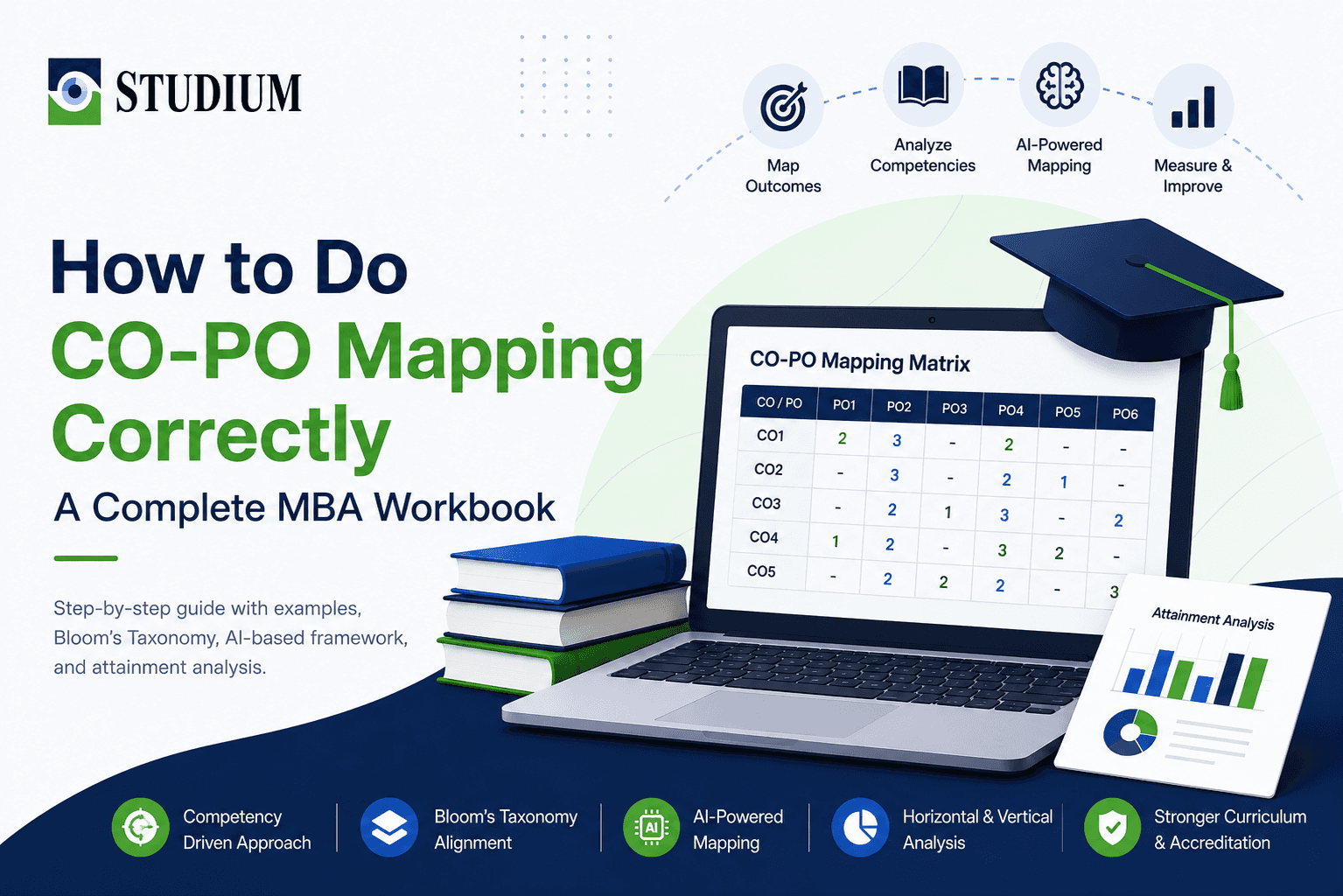
CO-PO mapping is one of the most important — and most misunderstood — components of Outcome Based Education (OBE).
Across institutions, faculty members spend significant time creating CO-PO mapping matrices for accreditation, attainment calculation, and academic documentation. However, in many cases, the mapping exercise becomes mechanical rather than meaningful.
Commonly observed issues include:
Random mapping of Course Outcomes (COs) to all Program Outcomes (POs)
Lack of competency-level thinking
Incorrect Bloom’s taxonomy alignment
Mapping based only on compliance requirements
Weak academic justification behind the mapping values
As a result:
Courses lose focus
Program outcomes become diluted
Attainment calculations lose meaning
OBE becomes a documentation exercise rather than an academic intelligence system
The real purpose of CO-PO mapping is NOT to “Fill a Table.”
Its purpose is to answer a much deeper academic question:
“How does this course contribute to the larger program-level competencies that the institution wants to develop?”
In this workbook-style guide, we will demonstrate a structured and academically meaningful framework for CO-PO mapping using:
Official AICTE MBA Program Outcomes
A real MBA course example: Marketing Strategies
Bloom’s taxonomy analysis
Competency mapping logic
Sparse vs Dense mapping philosophy
Horizontal and vertical average analysis
This is also the exact academic framework adopted within Studium’s Smart OBE platform to simplify and strengthen CO-PO mapping.
Understanding CO-PO Mapping in Outcome-Based Education
What is CO-PO Mapping?
CO-PO mapping is the process of aligning:
Course Outcomes (COs)
Program Outcomes (POs)
This helps institutions understand:
Which courses contribute to which program outcomes
At what strength the contribution exists
Whether the curriculum is academically balanced
Whether the program is capable of delivering the expected graduate competencies
In OBE, no course exists in isolation.
Every course is expected to contribute towards broader program-level learning objectives.
Why Most CO-PO Mapping Exercises Fail
In many institutions, CO-PO mapping is done:
After teaching is completed
Under accreditation pressure
Without competency-level thinking
Using generic templates
This creates several problems:
1. Over-Mapping of Outcomes
Faculty often map every CO with multiple POs.
The assumption becomes:
“More mapping means better coverage.”
However, this usually creates shallow academic alignment.
2. Bloom’s Taxonomy is Ignored
The depth of learning expected at the course level is often different from the depth expected at the program level.
Without Bloom’s alignment:
mappings become weak
assessments become inconsistent
attainment loses meaning
3. Competencies Are Never Explicitly Defined
Most institutions directly start writing COs.
However, before writing outcomes, faculty should identify:
What competencies students should gain
What thinking depth is expected
What academic transformation the course should create.
Official AICTE MBA Program Outcomes
For this workbook, let us use the official AICTE MBA/Management Program Outcomes.
AICTE MBA Program Outcomes (Simplified)
PO1 - Apply knowledge of management theories and practices
PO2 - Foster analytical and critical thinking abilities
PO3 - Ability to perform effectively as an individual and team member
PO4 - Ability to use management techniques for problem-solving
PO5 - Ability to understand ethical responsibilities
PO6 - Ability to communicate effectively
Understanding Thinking Levels in OBE
Before doing CO-PO mapping, institutions must understand Bloom’s taxonomy and thinking levels.
Low-Order Thinking
Focuses on:
Remember
Understand
Apply
Typically used in:
Introductory courses
Foundation-level subjects
Medium-Order Thinking
Focuses on:
• Analyze
Students begin:
Breaking concepts
Identifying patterns
Comparing frameworks
Interpreting data.
High-Order Thinking
Focuses on:
Evaluate
Create
Students are expected to:
Make judgments
Solve strategic problems
Build solutions
Design new approaches
Create business strategies
Example Course: Marketing Strategies
Marketing Strategies is a high-order thinking MBA course.
Why?
Because the course expects students to:
Analyze markets
Evaluate strategic options
Make business decisions
Create marketing plans.
This means the dominant Bloom’s levels will largely be:
Analyze
Evaluate
Create
Step 1: Identify Core Competencies
Before writing Course Outcomes, faculty should first identify:
“What are the key competencies students should develop through this course?”
Example Competencies for Marketing Strategies
C1 - Market Analysis
C2 - Strategic Thinking
C3 - Consumer Behavior Interpretation
C4 - Marketing Decision-Making
C5 - Campaign Design
C6 - Problem Solving
These competencies define:
What the course intends to deliver
What students should become capable of
What should eventually be measured
Step 2: Define Program Outcomes with Competencies & Bloom’s Taxonomy
The next step is to break Program Outcomes into:
Core competencies
Bloom’s taxonomy levels
Example PO Breakdown
PO1 - Management Knowledge Application - Apply
PO2 - Analytical Thinking - Analyze
PO3 - Teamwork & Collaboration - Apply
PO4 - Problem Solving - Evaluate
PO5 - Ethical Decision Making - Evaluate
PO6 - Communication Skills - Apply
This creates clarity on:
What each PO actually means
What depth of learning is expected.
Step 3: Frame Course Outcomes (COs)
Now we write measurable Course Outcomes.
Recommended CO Writing Structure
To + Bloom’s Action Verb + Competency + Learning Impact
Course Outcomes for Marketing Strategies
CO | Course Outcome | Competency | Bloom's Level |
|---|---|---|---|
CO1 | Analyze market segmentation and targeting strategies for different business contexts | Market Analysis | Analyze |
CO2 | Evaluate consumer behavior data to support strategic marketing decisions | Consumer Behavior Interpretation | Evaluate |
CO3 | Design integrated marketing strategies for competitive business environments | Campaign Design | Create |
CO4 | Recommend data-driven marketing solutions for real-world business problems | Problem Solving | Evaluate |
CO5 | Develop strategic communication plans for brand positioning and market engagement | Strategic Thinking | Create |
Dense Metrics vs Sparse Metrics Philosophy
One of the most important concepts in CO-PO mapping is understanding:
Dense Metrics Mapping
vs
Sparse Metrics Mapping
Dense Metrics Philosophy
In dense mapping:
• Institutions try to map every CO with as many POs as possible.
Example:
• 5 COs mapped with all 6 POs.
This creates:
excessive overlap
weak academic focus
shallow curriculum articulation.
The course starts trying to address too many program outcomes simultaneously.
As a result:
clarity reduces
teaching becomes scattered
attainment values become diluted
Sparse Metrics Philosophy (Recommended)
Sparse mapping follows a different philosophy.
It says:
“A course does not need to contribute to all Program Outcomes.”
Instead:
map only to the most relevant 40–50% of POs
wherever mapping exists, it should be strong and meaningful.
This creates:
Stronger academic alignment
Focused course delivery
Better outcome attainment
Clearer curriculum structure
The Actual CO-PO Mapping Framework
Now let us understand how the mapping should actually be performed.
Step 1: Compare Competencies
Before assigning mapping values:
Ask:
“Are the competencies of the CO and PO academically related?”
If competencies are NOT related: → assign “–”
If competencies ARE related: → move to Bloom’s comparison.
Step 2: Compare Bloom’s Taxonomy Levels
Now compare:
CO Bloom’s level
PO Bloom’s level
Mapping Logic
Condition | Mapping Value |
|---|---|
Exact Bloom's Match | 3 |
Close Alignment | 2 |
Weak Alignment | 1 |
Competency Mismatch | - |
Example
CO Bloom | PO Bloom | Mapping |
|---|---|---|
Apply | Apply | 3 |
Analyze | Evaluate | 2 |
Remember | Evaluate | 1 |
Competency mismatch | Any | - |
Example CO-PO Mapping Matrix
CO/PO | PO1 | PO2 | PO3 | PO4 | PO5 | PO6 |
|---|---|---|---|---|---|---|
CO1 | 2 | 3 | - | 2 | - | - |
CO2 | - | 3 | - | 2 | 1 | - |
CO3 | - | 2 | 1 | 3 | - | 2 |
CO4 | 1 | 2 | - | 3 | 2 | - |
C05 | - | 2 | 2 | 2 | - | 3 |
This matrix reflects:
focused mapping
meaningful academic alignment
sparse mapping philosophy
Horizontal Average Analysis
Formula
Horizontal Average for CO:
Average = (Sum of mapping values for one CO) / (Number of mapped POs)
Purpose
Horizontal average helps identify:
how strongly one CO contributes across program outcomes.
Example
For CO1:
(2 + 3 + 2) / 3 = 2.33
This indicates:
CO1 has strong alignment with the mapped program outcomes.
Vertical Average Analysis
Formula
Vertical Average for PO:
Average = (Sum of mapping values for one PO) / (Number of mapped COs)
Purpose
Vertical average helps identify:
• how strongly the curriculum supports a particular program outcome
Example
For PO2:
(3 + 3 + 2 + 2 + 2) / 5 = 2.4
This indicates:
the curriculum strongly supports analytical thinking.
Interpreting Mapping Quality
Average Score | Interpretation |
|---|---|
Below 1.5 | Weak Alignment |
1.5 – 2.5 | Good Alignment |
Above 2.5 | Very Strong Alignment |
Important Academic Insight
Both extremes must be checked carefully.
Very Low Scores
May indicate:
Weak alignment
Incorrect CO framing
Poor curriculum integration.
Extremely High Scores Everywhere
May indicate:
Over-mapping
Dense mapping
Artificial inflation.
What Faculty Members Should Check
Program coordinators should evaluate:
curriculum balance
distribution of mappings
overlap between subjects
whether all POs are reasonably supported.
They should identify:
over-dominant POs
neglected POs
curriculum gaps.
What IQAC Teams Should Check
IQAC teams should focus on:
consistency of mapping methodology
auditability
articulation quality
curriculum alignment
academic rigor.
IQAC should ensure that:
mapping logic is academically justified
Bloom’s taxonomy is correctly applied
attainment calculations are meaningful.
How AI is Transforming CO-PO Mapping
Traditional CO-PO mapping is heavily manual and subjective.
Modern AI-powered OBE systems can now help institutions:
extract competencies automatically
identify Bloom’s taxonomy
suggest mapping recommendations
detect over-mapping
generate articulation insights.
This reduces:
faculty workload
inconsistency
documentation burden.
Smart OBE and AI-Based CO-PO Mapping
Studium’s Smart OBE platform follows the exact framework discussed in this workbook.
The platform helps institutions:
analyze competencies
identify Bloom’s levels
perform intelligent CO-PO mapping
implement sparse mapping philosophy
generate mapping quality insights.
The objective is not merely automation.
The objective is to improve:
academic quality
curriculum intelligence
outcome-based decision-making.
Final Thoughts
CO-PO mapping should never be treated as a documentation table.
It is one of the most powerful academic exercises in Outcome-Based Education because it defines:
what the course contributes
how the curriculum is structured
what competencies students ultimately develop.
Institutions that adopt meaningful, competency-driven, and Bloom’s-aligned CO-PO mapping frameworks create:
stronger curriculum design
better attainment quality
more focused learning systems.
The future of CO-PO mapping lies in:
academic intelligence
structured articulation
AI-assisted decision-making.
Frequently Asked Questions (FAQs)
What is CO-PO mapping?
CO-PO mapping is the process of aligning Course Outcomes with Program Outcomes to understand how courses contribute toward broader program competencies.
What is sparse mapping in OBE?
Sparse mapping is a philosophy where courses are mapped only to the most relevant Program Outcomes with stronger alignment instead of mapping everything with everything.
What is dense mapping?
Dense mapping refers to excessive mapping of COs with many POs, often resulting in shallow academic alignment.
How are CO-PO mapping values assigned?
Mapping values are assigned by comparing competency relevance and Bloom’s taxonomy alignment between COs and POs.
What do mapping values 1, 2, and 3 mean?
Typically:
1 = weak alignment
2 = moderate alignment
3 = strong alignment
Why is Bloom’s taxonomy important in CO-PO mapping?
Bloom’s taxonomy helps ensure that the depth of learning expected at the course level matches the program-level expectations.
What is horizontal average in CO-PO mapping?
Horizontal average measures how strongly one Course Outcome contributes across mapped Program Outcomes.
What is vertical average in CO-PO mapping?
Vertical average measures how strongly the curriculum supports a particular Program Outcome
