Get in Touch
contact@studiumtech.in
+91 83292 40103

About Studium
Accredibl
Benchmark
Careers
Copyright
|
Privacy Policy
|
Terms of use
Is India’s Degree-Driven System Failing Its Students? A Skill-First Wake-Up Call for Higher Education
The Context Behind the Change
As India’s workforce dynamics rapidly evolve, higher education is shifting away from traditional degree-centric models toward skill-first learning, according to a January 21, 2026 Economic Times Education article. The piece highlights how Indian universities in 2026 are placing skills, adaptability, and real-world relevance at the centre of the academic experience, driven by employer demand for graduates who can apply knowledge and solve problems in fast-changing industries.
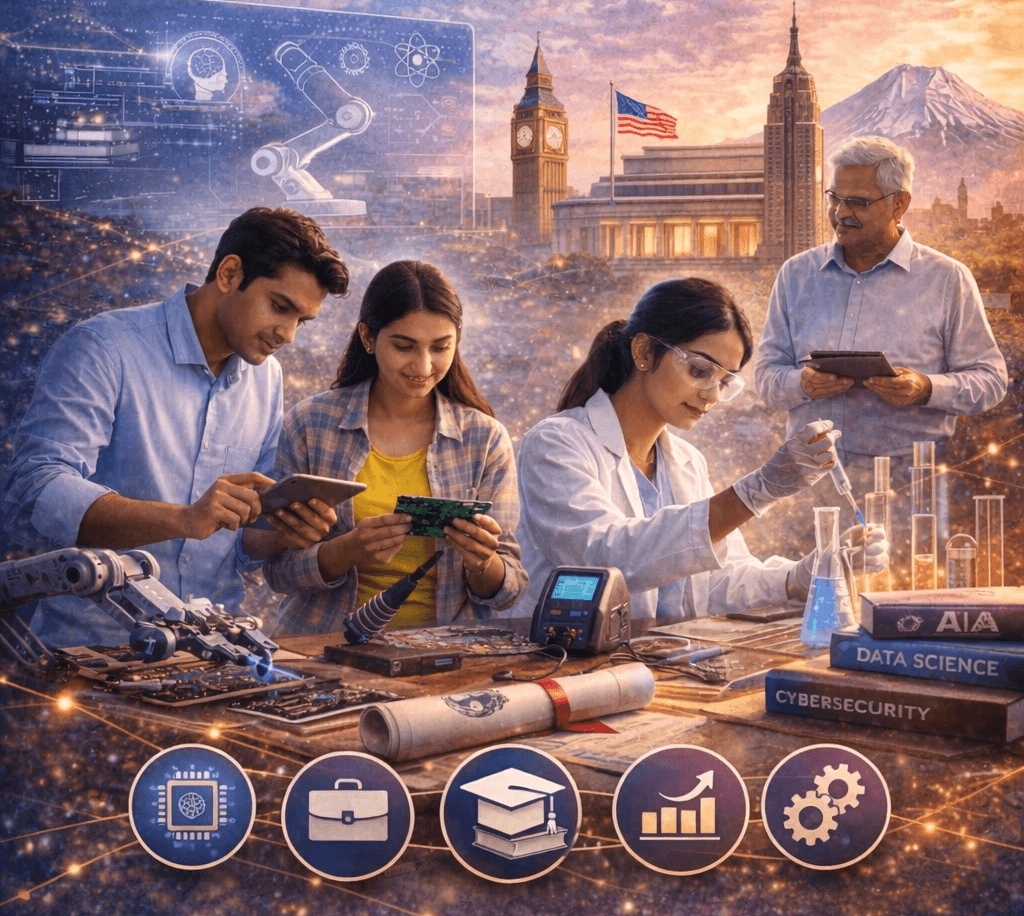
This transformation includes the rise of micro-credentials, modular programmes, and industry-aligned certifications in areas like AI, data analytics, digital design, and sustainability. Universities are also weaving artificial intelligence into curricula and using AI-powered analytics to personalise learning pathways and improve student outcomes. Closer collaboration with industry — through internships, apprenticeships, and innovation labs — is becoming mainstream rather than optional. Interdisciplinary learning models are breaking down traditional silos, equipping students for complex future workforces.
In this new paradigm, education increasingly aligns with career-embedded learning and continuous upskilling rather than solely on degree attainment.
The Impact Matrix
Signals an urgent rethink of traditional degree-focused pathways in favour of competency and employability-driven models.
Encourages universities to embed industry-relevant skills, technology fluency, and practical experience into core programmes.
Expanded use of AI and analytics could transform teaching roles—from content delivery to mentorship and personalised guidance.
Promotes micro-credentials and stackable certifications, allowing learners to update skills without repeating entire degree cycles.
Could widen the employability gap for institutions that lag in updating curriculum and industry engagement.
Encourages greater university-industry partnerships, shaping education around real-world needs, not just academic theory.
Drives a broader ecosystem shift toward lifelong learning and continuous skill development in response to automation and technological change.
Through the Studium Lens
At Studium, we see the skill-first transformation as both an opportunity and a challenge for higher education institutions. As universities restructure curricula to prioritise real-world skills and industry alignment, quality assurance frameworks, data coherence, and performance measurement become even more critical.
Studium’s AI-driven accreditation and quality management platform helps institutions centralise data workflows, track learning outcomes, and generate evidence-ready reports aligned with quality and employability benchmarks like NAAC, NBA, and NIRF. By providing actionable analytics on student competencies, curriculum efficacy, and industry engagement outcomes, Studium supports institutions to not only adopt skill-first approaches but also demonstrate impact through data-backed insights. This empowers institutions to remain compliant with evolving regulatory expectations, improve academic performance, and sustain growth in a rapidly changing higher education landscape.
With Studium, colleges and universities can effectively position themselves as future-ready, skill-driven learning hubs, ensuring graduates are well prepared for tomorrow’s opportunities.
CEO’s Pull Quote
“When skills become the currency of employability, institutions must reinvent how they teach, assess, and demonstrate value. Studium enables institutions to transition confidently into this new paradigm by providing the tools to measure impact, ensure quality, and align academic outcomes with real-world needs.”
Jan 27, 2026
Read full article
Is India’s Degree-Driven System Failing Its Students? A Skill-First Wake-Up Call for Higher Education
Jan 27, 2026
Is India’s Degree-Driven System Failing Its Students? A Skill-First Wake-Up Call for Higher Education
Jan 27, 2026
The Context Behind the Change
As India’s workforce dynamics rapidly evolve, higher education is shifting away from traditional degree-centric models toward skill-first learning, according to a January 21, 2026 Economic Times Education article. The piece highlights how Indian universities in 2026 are placing skills, adaptability, and real-world relevance at the centre of the academic experience, driven by employer demand for graduates who can apply knowledge and solve problems in fast-changing industries.
This transformation includes the rise of micro-credentials, modular programmes, and industry-aligned certifications in areas like AI, data analytics, digital design, and sustainability. Universities are also weaving artificial intelligence into curricula and using AI-powered analytics to personalise learning pathways and improve student outcomes. Closer collaboration with industry — through internships, apprenticeships, and innovation labs — is becoming mainstream rather than optional. Interdisciplinary learning models are breaking down traditional silos, equipping students for complex future workforces.
In this new paradigm, education increasingly aligns with career-embedded learning and continuous upskilling rather than solely on degree attainment.
The Impact Matrix
Signals an urgent rethink of traditional degree-focused pathways in favour of competency and employability-driven models.
Encourages universities to embed industry-relevant skills, technology fluency, and practical experience into core programmes.
Expanded use of AI and analytics could transform teaching roles—from content delivery to mentorship and personalised guidance.
Promotes micro-credentials and stackable certifications, allowing learners to update skills without repeating entire degree cycles.
Could widen the employability gap for institutions that lag in updating curriculum and industry engagement.
Encourages greater university-industry partnerships, shaping education around real-world needs, not just academic theory.
Drives a broader ecosystem shift toward lifelong learning and continuous skill development in response to automation and technological change.
Through the Studium Lens
At Studium, we see the skill-first transformation as both an opportunity and a challenge for higher education institutions. As universities restructure curricula to prioritise real-world skills and industry alignment, quality assurance frameworks, data coherence, and performance measurement become even more critical.
Studium’s AI-driven accreditation and quality management platform helps institutions centralise data workflows, track learning outcomes, and generate evidence-ready reports aligned with quality and employability benchmarks like NAAC, NBA, and NIRF. By providing actionable analytics on student competencies, curriculum efficacy, and industry engagement outcomes, Studium supports institutions to not only adopt skill-first approaches but also demonstrate impact through data-backed insights. This empowers institutions to remain compliant with evolving regulatory expectations, improve academic performance, and sustain growth in a rapidly changing higher education landscape.
With Studium, colleges and universities can effectively position themselves as future-ready, skill-driven learning hubs, ensuring graduates are well prepared for tomorrow’s opportunities.
CEO’s Pull Quote
“When skills become the currency of employability, institutions must reinvent how they teach, assess, and demonstrate value. Studium enables institutions to transition confidently into this new paradigm by providing the tools to measure impact, ensure quality, and align academic outcomes with real-world needs.”
Read full article